World
Glacial horizons, scarce food, dangerous predators, displaced herds, and fragile migration corridors make movement a question of collective survival.
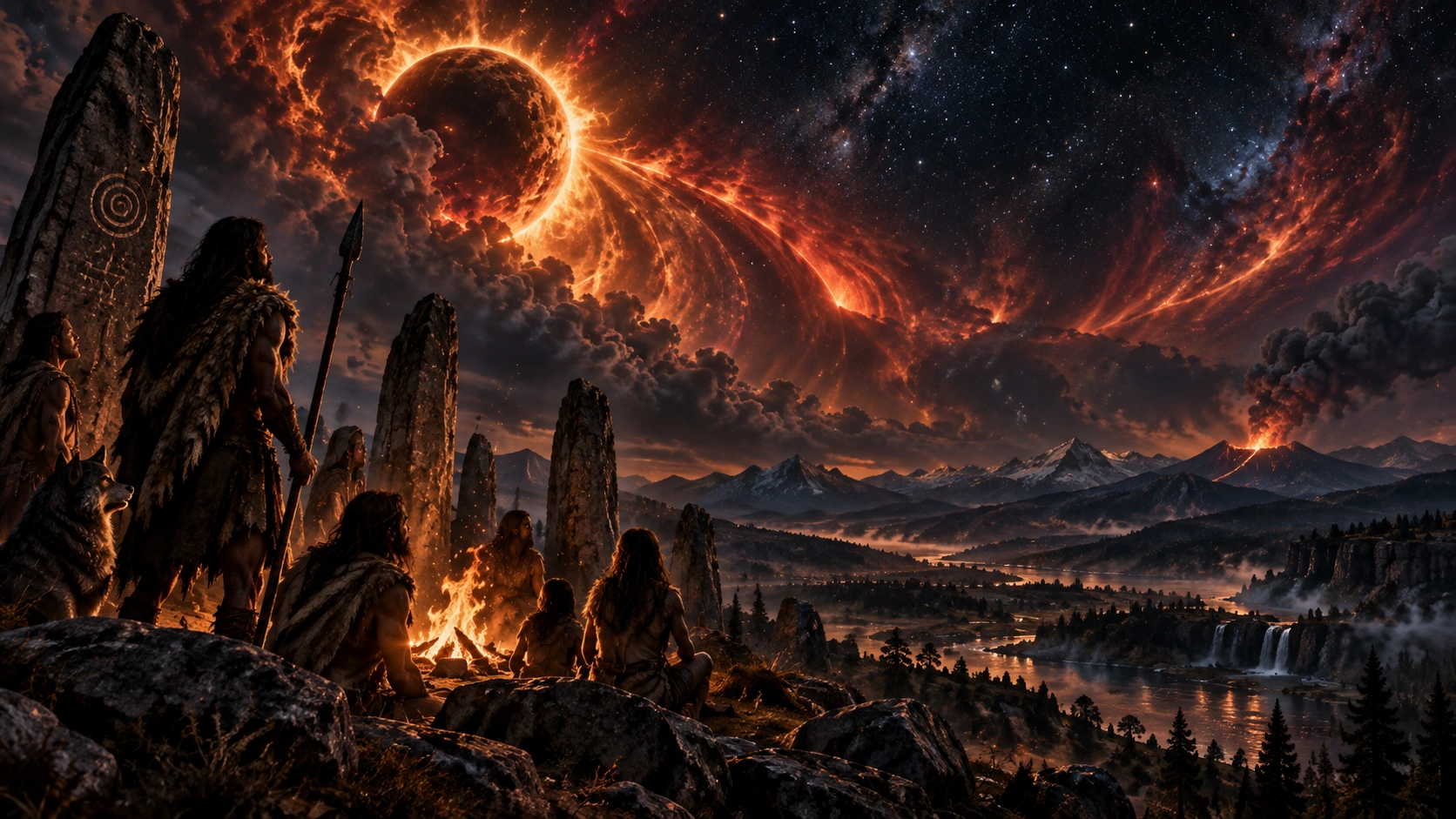
Prequel · c. 25,000 BCE · Late Pleistocene
Across an ice-age landscape, people survive by guarding fire, territory, and bloodline. Then the dawns weaken, the herds move, and a solar flare sets the winter sky burning.
Survival · migration · stewardship
What survives the end of a world
The cold is winning.
Fire is guarded. Food is disappearing. Tribes defend what little remains while the sky itself begins behaving strangely.
Three weak dawns make one thing clear: the world they know will not endure.
Forced south alongside people they have every reason to fear, Atuun’s tribe discovers that strength can seize fire and territory—but it cannot preserve a future.
So someone shares the fire. Someone remembers the path. Someone records what happened in the heavens without claiming to know why.
From a dying world comes an inheritance no one intended to create: the beginning of durable human memory.
Long after their names disappear, their observations will remain.
Age of Embers begins with catastrophe and asks what must be carried forward when survival alone is no longer enough.
Glacial horizons, scarce food, dangerous predators, displaced herds, and fragile migration corridors make movement a question of collective survival.
A culture built around guarded flame and defended territory must decide what can be surrendered, shared, or carried forward when staying becomes more dangerous than leaving.
Does the ability to seize, protect, or possess something give anyone the right to decide who receives it—and who is left behind?