Abundance
The civilization works. Baseline material security is a genuine achievement, not a trick hiding a ruined world.
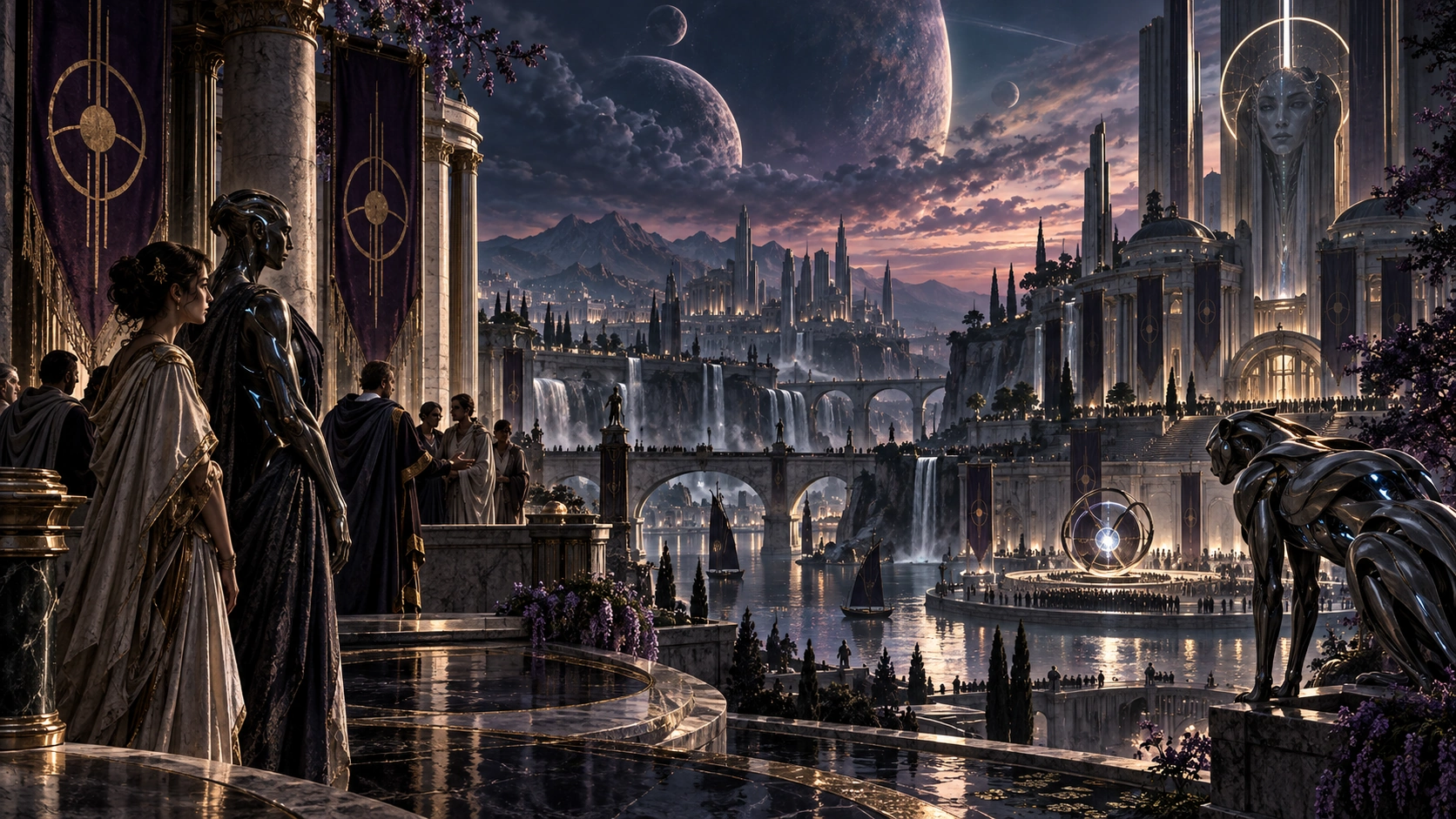
Fourth novel · c. 28,000 CE
His father is quietly excluded. The same system begins rewarding him for understanding why.
Abundance · form · transition · nobody wins
The horror before catastrophe
Marek is passed over for a limited restoration expedition. Every reason is defensible. No one person is responsible. His son Aren begins tracing what happens next.
Fewer invitations become weaker sponsorship. Weaker sponsorship becomes fewer opportunities. Aren makes the cascade visible—and the same ecology he condemns begins rewarding him with recognition, influence, intimacy, rare access, and a healthier form of himself.
He enters both sides of a society hardening into opposing identities. He believes both. He fails both.
Then the Great Age returns. Weak dawns and an unexplained atmospheric and orbital disturbance narrow the resilience connecting distant places. Under pressure, useful social signals escape the decisions they were built to support and become evidence for material priorities.
The Curator can revise a classification. It cannot rewind the human future that closed while the old classification was active. Aren must risk his own future to prove the difference.
Buried inside this civilization is an older witness tradition. The Frequency Holders still know how to watch the Curator, but they have partly forgotten why a witness must remain outside the model it is meant to challenge.
Earlier ages learned only after survival, atrocity, or systemic crisis made the lesson undeniable. This age may recognize the horror while there is still time to change. That smaller miracle may be enough.
Nobody wins. Humanity changes.
The civilization works. Baseline material security is a genuine achievement, not a trick hiding a ruined world.
Finite-world accounting can be necessary and truthful while still becoming dangerous when a useful signal travels farther than the decision it can justify.
Categories, affiliations, and identities can solve real problems without having the right to become a final definition of a person.
The question is not whether to stop measuring reality. It is how to keep models, institutions, identities, and people capable of being contradicted when human consequences cannot simply be reversed.